PREVIOUS
Sydney Trains And SYSTRA Partner To Deliver Nextgen Digital Train Radio System



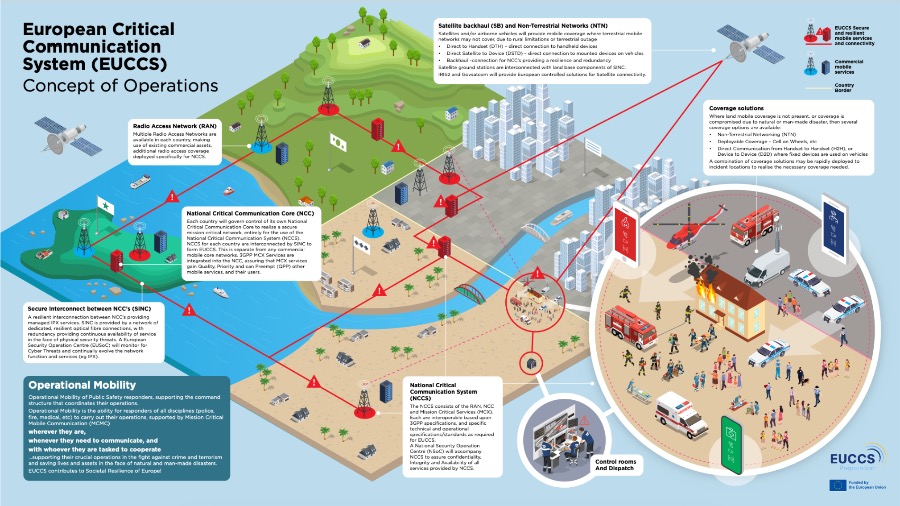
The European Critical Communication System (EUCCS) will realise Operational Mobility and Shared Situational Awareness: Helping our Public Safety response community to work together using mobile technology to keep our society safe and secure across Europe.
EUCCS is a policy priority for the European Commission as identified in the EC Work programme 20261. The EUCCS plan aims for gradual establishment of EUCCS with the first functional system by 2030 supported by a legislative proposal made in Q3 2026. EUCCS will integrate National Critical Communication Systems (NCCS) of all EU and Schengen associated states.
Figure 1 illustrates the high-level Operational Concept of EUCCS. EUCCS will provide the necessary mobile communication needed to help responders to cooperate in many circumstances of multi-agency, multi country response which cannot be easily achieved across Europe with the technology in-use today. These situations demand technical interoperability to match and support the interoperability of responders themselves, such as responding to a car crash at a border crossing, flooding spanning multiple countries, wildfire requiring multi-national response, or criminal pursuits across international boundaries.
EUCCS is presented by example of four countries illustrating diUerent terrain including Urban, Hilly countryside, sparse rural landmass, and an island. Each present diUerent challenges for mobile coverage. Each country will host its own National Critical Communication System (NCCS), which will be a secure and resilient mobile communication system.
NCCS will comprise of 2 main functions, the National Critical Communication Core (NCC) providing Mission Critical (MCX) services and Radio Access Network (RAN). All functions are founded by 3GPP specifications, allowing for compatibility and interoperability. NCC integrates with RAN, which will be a combination of RAN shared with commercial mobile services, and RAN deployed specifically to cover not spots, especially where the country will have available spectrum for this purpose. The relation between governments and commercial operators, and their assets will be diUerent in each country with regard to RAN and NCC.
Mission Critical services (MCX) provide the mobile services needed for the exchange of information to support the operations of Public Safety responders and their command structure. MCX services are tightly integrated with NCC to provide NCCS, ensuring highly resilient and available mobile MCX services for our responders. Responders should experience use of the technology and services ‘same as home’, wherever they may roam.
There will be continuous innovation of NCCS to evolve the capabilities of EUCCS as a whole. This will make use of the outcome of EC Horizon Europe programmes, and associated standardisation. New innovations in 5G will be adopted and move towards 6G. Innovation outcomes will enhance the exchange, distribution and management of situation awareness information to better support the processes and procedures of our responder community.
The red lines in Figure 1 illustrate the Secure and resilient interconnect (SINC) between NCC’s of each country, allowing for cross border mobility (aka roaming). Public Safety responders are therefore Operationally Mobile. Operational Mobility is the ability for Responders to carry out their Operations, exchanging Situational Awareness information with MCX services:
- wherever they are
- whenever they need to communicate, and
- with whoever they are tasked to collaborate
Coverage Solutions provide RAN coverage where land mobile RAN is not present or not functioning. Satellitecommunication services further provide additional coverage and resilience, throughout Europe.
Responders of diUerent disciplines can work together with diUerent devices and applications, allowing the sharing of situational awareness information in the context of their operational role, and supporting their daily work.
NOTE: This is a concept of operations illustration of EUCCS. Each country will make its own choices on how to procure, deploy and govern their National Critical Communication System (NCCS) component of EUCCS.