PREVIOUS
Thales, Singtel Group and Bridge Alliance enable world’s first multi-operator IoT eSIM network in Asia Pacific



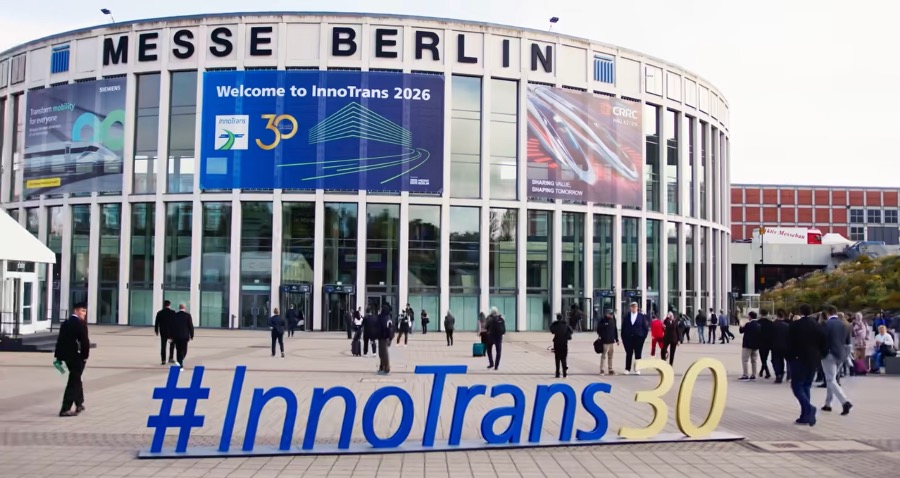
Berlin, Germany — 22–25 September 2026, InnoTrans 2026, the 15th edition of the biennial event, closed on 25 September with record participation. Messe Berlin reported approximately 175,000 trade visitors from more than 120 countries, 3,190 exhibitors from 59 countries and 180 world premieres. The outdoor and track area featured 113 vehicles from 17 countries, highlighting developments ranging from alternative propulsion and automation to software-defined rolling stock.
For the European railway communications sector, however, one of the most significant themes was the continued development and preparation of the Future Railway Mobile Communication System (FRMCS). Demonstrations, field trials, migration discussions and vendor announcements showed an industry moving beyond laboratory concepts toward increasingly realistic validation and pre-deployment activities.
Current European FRMCS activity remains focused on specification development, testing, interoperability and preparation for deployment rather than widespread operational rollout.
Europe’s Rail Joint Undertaking presented FRMCS activities at InnoTrans through its FRMCS Deployment Group, which reported on work covering deployment technology, finance and legal issues, scenarios and alignment. During the event, the group also discussed the latest status of FRMCS specification development and priorities for pre-deployment activities. Europe’s Rail said testing is expected to conclude in September 2027.
The FP2-MORANE-2 programme remains a major component of this work. Its objective is to validate FRMCS technologies and interoperability under realistic railway conditions and to support the industry's preparation for migration from GSM-R.
In July 2026, Ericsson and DB InfraGO conducted an end-to-end FRMCS trial on real trains in Germany's Ore Mountains. Ericsson reported validation of radio performance and coverage in the target 1900 MHz railway frequency band, including comparison of field measurements with network-planning simulations and testing related to GSM-R transition and cross-border scenarios. Ericsson described the activity as a pre-MORANE-2 trial preparing the organisations for subsequent work.
At InnoTrans, Europe’s Rail hosted its programme in Hall 4.2, Stand 260, bringing together European institutions, research programmes and industry stakeholders. The programme included FRMCS discussions alongside activities covering digital freight, autonomous rail operation, signalling and railway digitalisation.
The wider institutional programme also included the launch of the European Network of Infrastructure Managers (ENIM) at the InnoTrans Convention. Messe Berlin identified the ENIM kickoff as one of the major institutional events of the 2026 edition.
The overall message from the show was therefore less about an immediate GSM-R replacement and more about building the technical, regulatory and operational foundations required for the eventual transition to FRMCS.
Nokia positioned its InnoTrans 2026 presence around an end-to-end FRMCS communications architecture spanning onboard solutions, radio access technologies, transmission and data-centre networks, 5G Core, MCX, cybersecurity, and deployment and migration services.
The company's approach combines a secure and resilient 5G radio access layer with IP/Optical WAN and data-centre infrastructure connecting trains, wayside systems, automation systems and control centres. Nokia also highlighted services intended to help railway operators migrate from existing communications infrastructure while maintaining operational continuity.
Nokia's InnoTrans messaging reflects the growing emphasis on an integrated communications architecture in which FRMCS is part of a broader railway ICT environment rather than an isolated radio replacement.
Ericsson demonstrated how its FRMCS technologies can be applied in realistic railway environments.
The company's showcase drew on its recent work with DB InfraGO and its broader rail communications portfolio. Ericsson also highlighted its role in Queensland's The Wave programme, where it is involved in deploying a 5G-enabled Digital Radio System.
The equipment and technologies presented included:
Radio 8883 RW for outdoor railway sites
Radio 4474 N100 for space- and power-constrained locations
RAN Compute 6381 for distributed processing
MINI-LINK 6355 and Fronthaul 6585 for transport and synchronisation
Railway-oriented antennas including 9011, 2405 and 2411
Battery 6320 and Power 6308 for site resilience
Ericsson also highlighted device and interoperability testing through its Düsseldorf facilities, together with radio planning, coverage verification, optimisation and site deployment activities.
The company linked these capabilities to future railway applications including automated operations, positioning, intelligent sensing, AI-supported maintenance and Mission-Critical Push-to-Talk alongside ETCS.
Ericsson executives described the objective as helping operators establish a practical route from current GSM-R infrastructure toward secure 5G-based railway communications.
Kontron Transportation presented its FRMCS strategy around a unified railway communications platform.
A major element was its 5G Core for FRMCS, described by Kontron as a cloud-native architecture combining a 4G EPC and 5G Standalone Core. The platform uses a common subscriber and identity environment across the two generations and is designed to allow operators to maintain existing 4G capabilities while preparing for 5G SA and FRMCS.
Kontron also presented:
Private 4G/5G networks for railway operations
FRMCS modems and MCx solutions
MCx OTT capabilities
Smart Station applications
Traffic-management and dispatching functions
Network Operations Centre capabilities
Industrial Cloud and service-provisioning functions
The company's approach illustrates a broader industry trend toward treating FRMCS migration as part of an integrated railway communications and ICT transformation.
Funkwerk presented its MESA all family as a 5G/FRMCS-oriented onboard communications platform.
The family includes:
MESA all for voice and data over public and private 5G networks
MESA all compact, a compact 5G cab-radio configuration with integrated eSIM and support for 3G/4G/5G and MCX/FRMCS applications
MESA all multimode, a modular platform designed for 5G/FRMCS with the ability to integrate GSM-R or analogue radio modules for backward compatibility
Funkwerk also presented its migration strategy and participated in discussions around the future European railway communications architecture.
The company states that it will provide TSI-CCS-compliant onboard systems when FRMCS is introduced, while continuing to participate in European FRMCS standardisation, development and testing.
Alongside MESA all, Funkwerk presented RMX all, an open resilience-management system addressing device management, software updates and vulnerability handling.
Funkwerk's InnoTrans programme included three 90-minute workshops in CityCube Room R2 on 22, 23 and 24 September covering migration strategies from GSM-R toward FRMCS and MCX.
Funkwerk also presented its passenger-information business under the Funkwerk Mobility Solutions.
Quectel Wireless Solutions presented its RG660Qx LGA 5G module variant as part of its FRMCS evaluation and railway-development programme.
The company announced the variant on 3 September 2026, the module supports the FRMCS n100 and n101 bands and is accompanied by an adaptor board and evaluation-board kit intended for device-level testing and evaluation.
Quectel states that the module is based on Qualcomm Technologies' X85 and X82 5G Modem-RF platforms and supports up to 10 Gbps Ethernet and Power Class 1.5.
The product should be regarded as an FRMCS evaluation/development platform, rather than as evidence that operational FRMCS certification has already been completed.
SYSTRA used InnoTrans to discuss railway transformation, including the migration from GSM-R to FRMCS.
The consultancy presented the transition as a long-term programme affecting operational communications, safety, maintenance and infrastructure management, rather than simply a radio-network replacement.
SYSTRA expects FRMCS to begin gradually replacing GSM-R globally from around 2035. This should be understood as SYSTRA's industry outlook rather than a single worldwide regulatory switch-off date.
The company also presented work covering AI-enabled engineering, climate resilience and digital test-and-commissioning tools.
Cisco focused on railway communications infrastructure as part of critical transport infrastructure.
Its InnoTrans presentation included Cisco Unified Edge, bringing computing capabilities closer to trackside environments, together with its Sovereign Critical Infrastructure portfolio covering high-availability networking, cybersecurity and automation.
The company's positioning highlights the importance of the fixed IP, transport and edge-computing infrastructure supporting future FRMCS and digital railway services.
Artificial intelligence was one of the dominant themes of InnoTrans 2026. Messe Berlin highlighted the AI Mobility Lab and AI on Track hackathon as part of the show's programme.
Alstom presented its “Talk to my train” AI assistant, designed to help maintenance teams identify and address train problems more quickly.
Other manufacturers and technology companies demonstrated AI applications covering operations, maintenance, perception and railway asset management. CRRC, for example, presented its VELLINK intelligent metro vehicle, using multiple sensor inputs and intelligent perception technologies for track-condition recognition and fault warning.
The direction is clear: AI is increasingly being demonstrated not only as a research technology but as part of practical railway applications.
Siemens Mobility presented its Vectron X locomotive platform as a software-defined rolling-stock architecture.
The platform extends the Siemens Xcelerator ecosystem into rolling stock through open interfaces, standardised data structures and onboard applications. Siemens also demonstrated connections between Vectron X, signalling and digital asset-management technologies.
The outdoor exhibition additionally featured a Siemens Mireo for ÖBB Alpine long-distance services, a battery-powered Mireo Plus B for S-Bahn Mitteldeutschland and an Inspiro London train for the Piccadilly Line.
The outdoor and track area featured 113 vehicles from 17 countries, with alternative propulsion among the major themes.
Among the highlights were:
CRRC presented a 2,000 kW-class hydrogen fuel-cell hybrid locomotive featuring intelligent driving and multi-sensor perception technologies.
Stadler presented a hydrogen-powered narrow-gauge train intended for future passenger operations in Sardinia. The planned passenger-service entry is targeted for 2028.
CAF presented its Civity BEMU, which achieved a 273 km battery-only test run in Germany.
Hitachi Rail showcased the latest-generation ETR1000 alongside other rolling-stock technologies, including battery-electric solutions. Messe Berlin reported that the ETR1000 Frecciarossa and Hyundai Rotem EMU 320 can reach speeds of more than 300 km/h.
Digital Automatic Coupling (DAC) remained a major European rail-freight topic.
Europe’s Rail presented demonstrations comparing the DAC Basic Package with conventional screw-coupler technology in yard operations. The objective is to automate coupling-related processes and support more digitalised freight operations.
DAC can also enable the transfer of power and data through the coupling system, creating a technical foundation for greater automation, train monitoring and digital freight operations.
Rather than assigning a single universal time-saving figure, the practical benefits will depend on the operating environment, infrastructure and level of automation implemented.
Autonomous and remotely operated railway technology was another visible theme.
Railevo presented an autonomous rail-taxi concept, while Ferrovie dello Stato Italiane demonstrated unmanned-vehicle technology. Monocab, developed by TH Ostwestfalen-Lippe and partners, presented an autonomous monorail concept for regional applications.
Belgian company OTIV also demonstrated remote train-operation technology, including its work connecting remote driving with railway operations in the Netherlands.
Europe’s Rail additionally demonstrated autonomous depot movements through the FP2-R2DATO project, with trains operating without a driver onboard as part of the research demonstration programme.
Night-train concepts were another notable element of the outdoor and exhibition programme.
Messe Berlin highlighted the growing presence of new night-train concepts, including the ALISA project, a differentiated, lightweight and innovative sleeper-car concept involving Tricon and research partners including DLR.
These concepts reflect renewed industry interest in long-distance overnight rail, passenger comfort and more sustainable alternatives for selected travel markets.
Messe Berlin has confirmed that the inaugural InnoTrans Asia will take place at Singapore EXPO from 7–9 September 2027, while the next Berlin edition will follow in 2028.
For FRMCS, the nearer-term milestones are more specific. Europe's Rail continues testing and specification work, with testing expected to conclude in September 2027, while the FRMCS Deployment Group is already addressing deployment technology, financing, legal issues, scenarios and alignment.
The European railway industry's transition from GSM-R to FRMCS therefore remains a multi-stage process involving standards, interoperability testing, spectrum, onboard equipment, trackside infrastructure, core networks, cybersecurity and operational migration.
InnoTrans 2026 demonstrated that many of the technical building blocks are now being assembled: Nokia presented an end-to-end FRMCS architecture; Ericsson demonstrated field-tested 5G railway communications; Kontron presented a dual-mode 4G/5G Core approach; Funkwerk showed its 5G/FRMCS onboard platform; and Quectel introduced an RG660Qx variant aimed at early FRMCS evaluation.
The next phase will be less about demonstrating individual technologies and more about proving interoperability, completing specifications, establishing regulatory frameworks and preparing railway operators for practical migration. In that respect, InnoTrans 2026 provided a useful snapshot of an industry moving from research and validation toward the next stage of FRMCS deployment preparation.