PREVIOUS
FirstNet Strengthens Emergency Communications Across Southern Utah’s Rugged Terrain



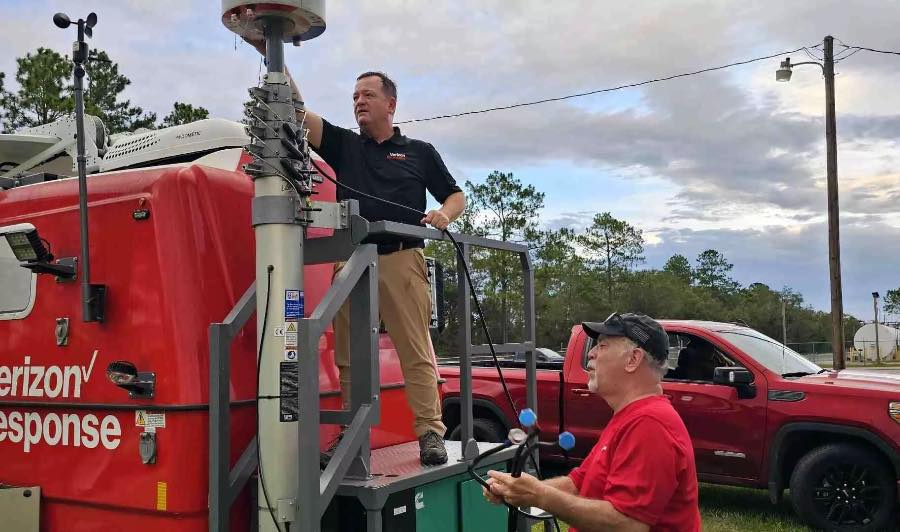
For many veterans, one of the greatest challenges of transitioning to civilian life is navigating the loss of identity. In the military, purpose is clear and the camaraderie built through shared adversity can be hard to find elsewhere.
But for Alex Brosky and Tetoya Gibson, the transition was an opportunity to build a new identity without losing their sense of mission. As Verizon Frontline Crisis Response Senior Managers, they now navigate the same high-stakes territory they once did in uniform.
Alex Brosky’s path was set in motion in 1983. While he was in high school, the Beirut Barracks Bombing killed 241 U.S. service members. Feeling compelled to do more, he joined the Marine Corps in 1986, serving as a Military Policeman for eight years.
Following his service, Alex spent years building a successful career in real estate and tech before joining Verizon in 2019. Based in Nashville, he managed network real estate and regulatory requirements for 5G Ultra Wideband deployment. He also took advantage of Verizon’s education benefits to graduate in cap and gown alongside his son in 2020 with his master’s degree in organizational leadership.
While Alex was established in his career building out the network, a disaster in 2021 shifted his focus. That year, a massive tornado struck his neighborhood, killing 12 people and leveling the house next door. Though his own home and car were damaged, Alex survived. Driven by that experience and the desire to help others who had faced similar trauma, Alex pivoted in early 2022 to the Verizon Frontline Crisis Response team.
His transition to the team was put to the test when Hurricane Ian struck Florida in 2022. As local agencies and first responders conducted more than 2,000 rescues in the first 72 hours, Alex was on the ground ensuring the network they relied on stayed operational. He navigated the chaos by blending his deep technical knowledge of infrastructure with the operational discipline he brought from the Marines.
“I’ve stood in the wreckage of the battlefield and my own neighborhood, so I know the weight of waiting for help. I joined this team to ensure that when a first responder or a victim reaches for a lifeline, the connection is always there.”
Like Alex, Tetoya Gibson’s path was driven by a desire to help others and tackle greater challenges. Over her 21-year career in the Air Force, her primary role involved loading missiles, bombs, and gun systems onto fighter jets. She was often one of few women in her field, at one point serving as the sole woman in a squadron of 251 people on her flightline.